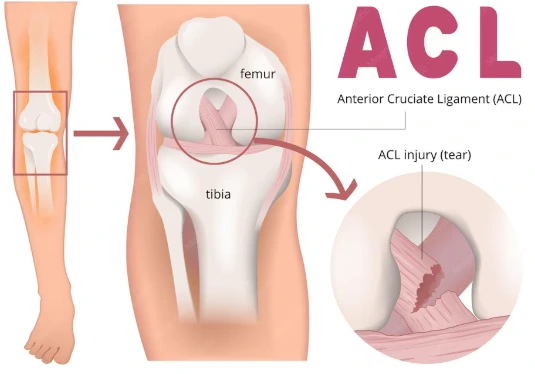
For anyone who suffers from a knee ligament injury, it is important to seek evaluation from an experienced specialist to understand the extent of the injury and appropriate treatment options. Dr. Rahul Modi at Arihant Superspeciality Hospital in Borivali West provides assessment and treatment for ACL injuries, with experience in sports medicine and arthroscopic procedures.
The anterior cruciate ligament (ACL) is one of the important ligaments supporting the knee joint. It connects the femur and tibia and helps control knee movements, particularly during twisting, pivoting, and sudden changes in direction. ACL injuries are common in sports such as football, basketball, and volleyball, but they can also occur during everyday activities involving sudden movements.
ACL injuries can range from partial ligament damage to complete ruptures. Common symptoms may include a popping sensation at the time of injury, swelling, knee pain, instability, and difficulty bearing weight on the affected leg.
Dr. Modi provides evaluation for patients with suspected knee ligament injury in Borivali. The diagnostic process may include a physical examination and clinical tests such as the Lachman test and anterior drawer test to assess knee stability. X-rays may be recommended to check for associated fractures, while MRI scans can provide detailed information about ligament and soft-tissue damage.
In selected cases, arthroscopy may be used as part of the evaluation and treatment process. This minimally invasive procedure involves inserting a small camera into the knee joint to examine the internal structures and assist in planning appropriate treatment.
Surgery is not required for every ACL injury. Treatment decisions depend on factors such as the extent of the ligament damage, the patient's activity level, age, lifestyle, and functional requirements.
For selected partial tears and less active patients, non-surgical management may include rest, ice, compression, elevation (RICE), physiotherapy, activity modification, and knee support when appropriate.
For certain complete ACL tears, particularly in active individuals or athletes who wish to return to sports involving pivoting movements, surgical reconstruction may be considered. ACL reconstruction generally involves replacing the damaged ligament with a graft, which may be obtained from the patient's hamstring, quadriceps, or another suitable tendon.
With training in sports medicine and arthroscopic surgery, Dr. Modi provides treatment options based on the individual patient's diagnosis and functional requirements.
The recovery period varies depending on the type of ACL injury, treatment approach, overall health, and rehabilitation progress. Non-surgical treatment may require several months of structured rehabilitation. Following ACL reconstruction, rehabilitation commonly continues for several months, with the timeline for returning to sports depending on strength, stability, movement control, and clinical assessment.
Physical therapy plays an important role in improving knee strength, mobility, balance, and movement patterns. Patients may be guided through exercises targeting the quadriceps, hamstrings, core muscles, and overall lower-limb stability to support rehabilitation and help reduce the risk of future injury.
Dr. Modi holds qualifications including MBBS, MS in Orthopaedics with gold medal distinction, DNB, and MNAMS. He has also completed specialized fellowship training in Sports Medicine, Arthroscopy, and Shoulder Surgery at Hospital Quirónsalud in Barcelona, Spain, along with a FIFA Diploma in Football Medicine.
His experience with different types of sports and ligament injuries allows him to evaluate each patient's condition and discuss suitable treatment options. Patients can also discuss the expected rehabilitation process, activity goals, and treatment considerations during consultation.