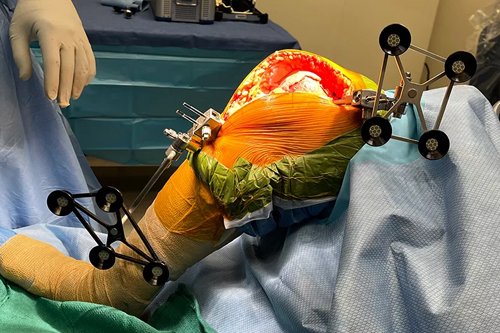
Robotic knee replacement is an advanced approach to knee replacement surgery that uses computer-assisted technology to help the surgeon plan and perform the procedure with greater precision. It allows treatment to be planned according to the patient's individual knee anatomy and condition.
Dr. Rahul Modi offers robotic-assisted knee replacement for patients with advanced knee damage who may benefit from joint replacement and are looking for a modern, precision-guided surgical approach.
Robotic knee replacement combines the expertise of the orthopaedic surgeon with advanced robotic technology. Before surgery, detailed planning helps determine the appropriate alignment and positioning of the knee implant. During the procedure, the technology assists the surgeon in carrying out the planned steps accurately.
The robot does not perform the surgery independently. The surgeon remains in control throughout the procedure and uses the technology as an aid during knee replacement.
Robotic knee replacement may be considered for patients with significant knee damage affecting comfort, movement, and daily activities.
- Advanced knee osteoarthritis
- Severe or persistent knee pain
- Significant joint damage
- Knee stiffness and reduced mobility
- Difficulty walking or climbing stairs
- Pain affecting daily activities
- Significant knee deformity
- Limited benefit from non-surgical treatment
Severe knee problems may gradually affect movement and quality of life. Common symptoms include:
- Persistent knee pain
- Pain while walking or standing
- Knee stiffness
- Swelling around the knee
- Difficulty climbing stairs
- Reduced range of motion
- Difficulty performing daily activities
- Knee deformity or altered alignment
Every knee replacement begins with a detailed clinical assessment. Your treatment plan may include examination of the knee, review of your symptoms and medical history, and appropriate imaging to understand the condition of the joint.
Robotic-assisted planning uses the patient's knee anatomy to help the surgeon plan implant positioning and alignment before the procedure.
The procedure is planned according to the patient's individual knee anatomy. During surgery, robotic-assisted technology helps the surgeon follow the planned alignment and implant positioning while the surgeon performs and controls the procedure.
- Detailed pre-operative assessment
- Patient-specific surgical planning
- Technology-assisted bone preparation
- Precise implant positioning
- Surgeon-controlled robotic assistance
- Intra-operative assessment
- Post-operative rehabilitation
- Follow-up care
Robotic-assisted knee replacement is designed to support accurate surgical planning and implant positioning. Depending on the patient's condition and overall health, potential benefits may include:
- Personalized surgical planning
- Greater precision in implant positioning
- Improved assessment of knee alignment
- Technology-assisted surgical accuracy
- Support for balanced knee function
- Structured rehabilitation after surgery
- Focus on restoring mobility
- Individualized post-operative care
Recovery varies from patient to patient and depends on overall health, knee condition, surgical findings, and rehabilitation progress. Early movement and physiotherapy are an important part of recovery after knee replacement.
Dr. Modi and the rehabilitation team will guide you through exercises, mobility, wound care, and follow-up appointments to support your recovery and return to daily activities.
You may benefit from an orthopaedic evaluation if knee pain or stiffness is making everyday activities difficult or if non-surgical treatments are no longer providing sufficient relief.
- Persistent or severe knee pain
- Difficulty walking or standing
- Increasing knee stiffness
- Difficulty using stairs
- Pain affecting sleep or daily life
- Reduced ability to remain active
- Significant knee deformity
- Limited improvement with non-surgical care
Is robotic knee replacement performed by a robot?
No. The surgeon performs the procedure. Robotic technology is used as an advanced surgical
aid for planning and precision during the operation.
Is robotic knee replacement suitable for everyone?
Not necessarily. Suitability depends on your knee condition, medical history, imaging,
and overall health. Your orthopaedic surgeon can recommend the most appropriate treatment
after evaluation.
How long does recovery take?
Recovery is different for every patient. Rehabilitation, physiotherapy, overall health,
and the complexity of the knee condition can all influence recovery time.
Will I need physiotherapy after knee replacement?
Rehabilitation and physiotherapy are generally an important part of recovery after knee
replacement. Your rehabilitation plan will be tailored to your progress and functional goals.
How do I know if I need knee replacement surgery?
A detailed orthopaedic consultation can help determine whether knee replacement is appropriate
based on your symptoms, examination, imaging, and response to non-surgical treatment.
Persistent knee pain should not be allowed to limit your daily life. Consult Dr. Rahul Modi for an expert assessment and discuss whether robotic-assisted knee replacement is appropriate for your condition.